Last updated: October 2026
Vermicompost is organic manure made by earthworms that eat cow dung and farm waste. Demand is growing from organic farmers, nurseries, home gardeners and terrace farmers. It is a low-investment business that fits well alongside dairy, goat farming or any farm with access to cow dung.
Quick Facts Investment₹2–3 lakh for a 20-bed unit SpaceAbout 2,000–3,000 sq ft under shade CycleAbout 45–60 days per batch Raw materialCow dung, crop waste, kitchen/market waste Best forFarmers, dairy owners, rural youth, women's groups
What You Need
- Vermi beds: ready HDPE beds (about 12 × 4 × 2 ft) or brick/cement pits
- Earthworms: Eisenia fetida (red wiggler) is the most common composting worm
- Shade: a shade-net or low-cost shed. Worms die in direct sun and heavy rain.
- Water supply: beds must stay moist, not wet
- Sieve, weighing scale, bag sealer
Investment (20-Bed Unit) ItemApprox. cost 20 HDPE vermi beds at ₹2,000₹40,000 Earthworms: 20 kg at ₹400/kg₹8,000 Shade-net shed₹1,50,000 Sieve, tools, scale, sealer₹30,000 Initial cow dung and raw material₹20,000 Total₹2,48,000
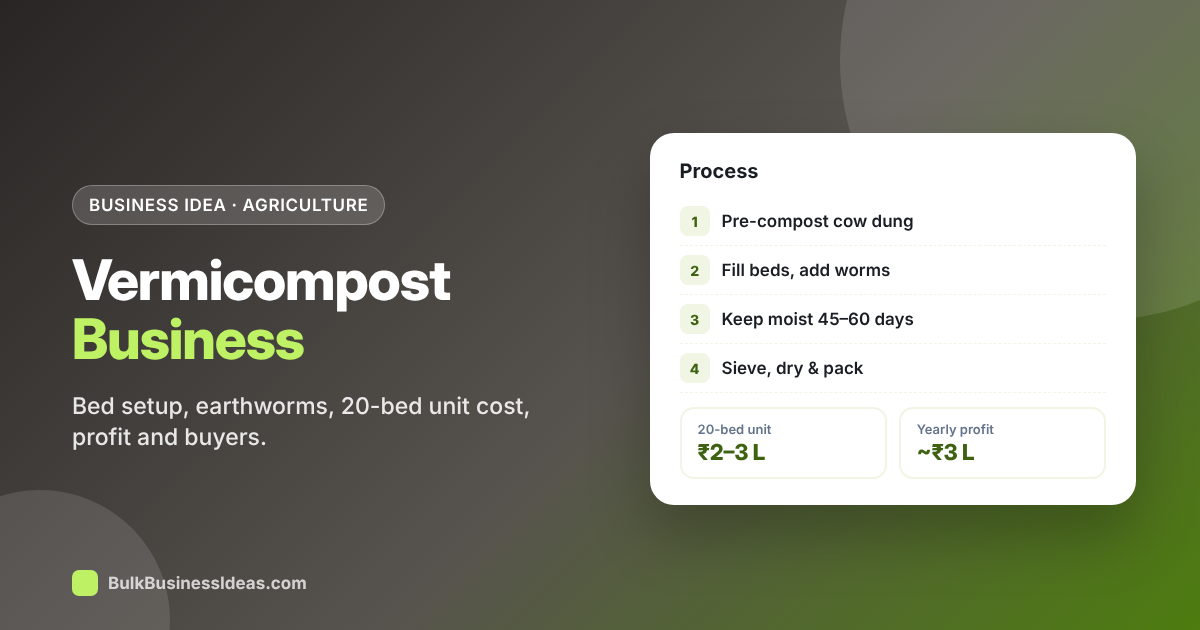
Process
- Pre-compost: partly decompose the cow dung and chopped crop waste for 2–3 weeks. Fresh hot dung can kill worms.
- Fill the beds with a base layer, then the pre-composted material.
- Add earthworms and cover with jute bags or dry leaves.
- Keep moist by sprinkling water regularly, without waterlogging.
- Harvest after 45–60 days when the top looks dark and granular. Stop watering a few days before.
- Sieve to separate the worms (reuse them) from the compost.
- Dry slightly and pack in 1 kg, 5 kg or 25–50 kg bags.
Simple Profit Example (Yearly, 20 Beds) Bulk sales: 50 tonnes at ₹7/kg (to farmers)₹3,50,000 Retail packs: 10 tonnes at ₹25/kg (nurseries, home gardeners)₹2,50,000 Extra earthworm sales₹40,000 Cow dung and raw material– ₹1,20,000 Labour– ₹1,20,000 Packaging– ₹60,000 Water, power, transport– ₹40,000 Profit before EMI₹3,00,000
Indicative only. Small retail packs for home gardeners give a much higher price per kg than bulk sales.
Where to Sell
- Farmers and FPOs, especially organic and horticulture farmers
- Plant nurseries and landscaping companies
- Home and terrace gardeners, through housing societies, Instagram and online marketplaces
- Agri-input shops
- Government and municipal tenders for organic manure
Licences
- To sell vermicompost as fertiliser, it should meet the standards under the Fertiliser Control Order, and many states require registration or authorisation from the agriculture department. Check with your district agriculture office.
- Udyam registration
- GST as applicable (GST guide)
- Get a lab test of your compost (NPK, moisture), since buyers and dealers ask for it
Support Available
Many states give subsidies for vermicompost units through agriculture and horticulture departments (under schemes like RKVY or organic farming missions). Rates differ by state. You can also use a Mudra loan. See Government Schemes for MSMEs.
Common Mistakes
- Using fresh, hot cow dung, which kills worms
- No shade or drainage, so worms die in heat or rain
- Selling only in bulk at low prices. Add retail packs.
Common Questions How much vermicompost does one bed give?
It depends on bed size and raw material. A standard HDPE bed typically gives a few hundred kilograms per cycle.
Can I start at home?
Yes. Small bins work for learning and home use. Commercial scale needs beds and a shaded area.
Where do I buy earthworms?
From existing vermicompost producers, KVKs and agricultural universities.
Disclaimer: Costs, prices and licence rules are indicative and vary by state. Confirm with your district agriculture office.
Comments (0)
Login to leave a comment.
No comments yet. Be the first to share your thoughts.