Last updated: October 2026
Masala is bought by every household, hotel and caterer, every single month. Demand never stops. A small spice grinding and packing unit is one of the easiest food businesses to start, and you can grow it step by step: from turmeric, chilli and coriander powder to blended masalas like garam masala, chhole masala and pav bhaji masala.
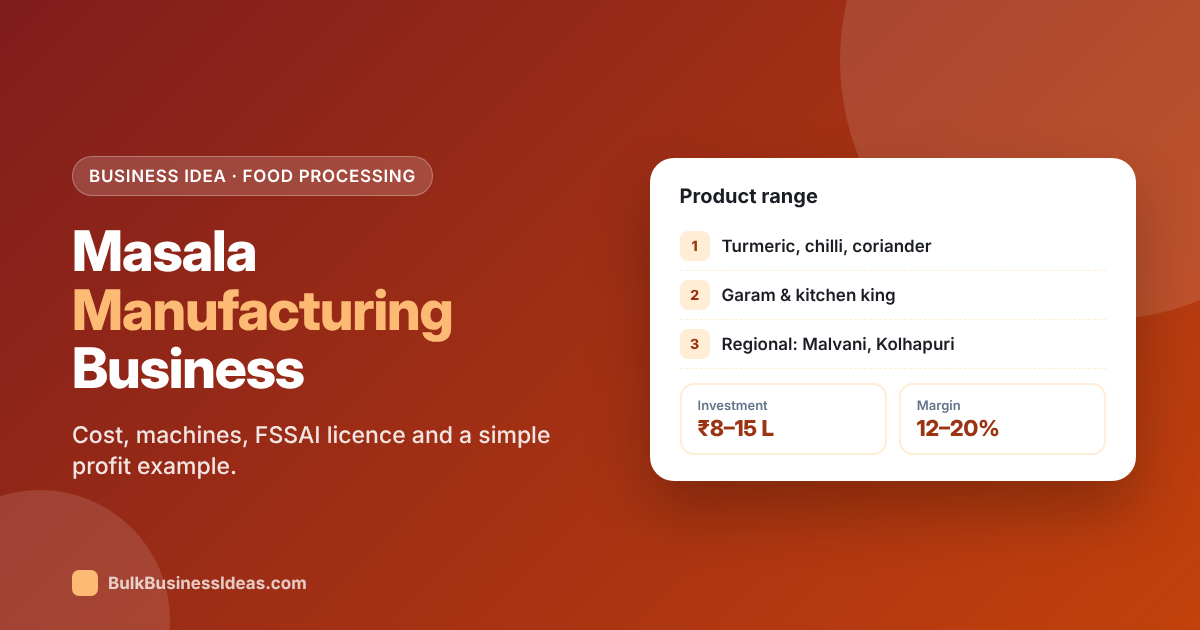
Quick Facts Investment₹8–15 lakh (small unit) Space500–1,000 sq ft Staff3–5 people Main licencesFSSAI, Udyam, GST, Legal Metrology Typical margin12–20% (higher for blended masalas) Best forAnyone with local market contacts; good for women entrepreneurs
What Products Can You Make?
- Straight powders: turmeric, red chilli, coriander, cumin. High volume, lower margin.
- Blended masalas: garam masala, kitchen king, sambar, biryani, chaat. Better margins and brand value.
- Regional specials: Malvani, Kolhapuri, goda masala and others. Strong local loyalty, little big-brand competition.
Tip: Start with 3–4 straight powders for volume, and add 2–3 blends as your "hero" products.
Investment Breakdown (Approx.) ItemCost Machinery (pulverizer, cleaner, roaster, sifter, mixer)₹3–6 lakh Pouch packing machine + sealer + weighing scale₹1.5–3 lakh Shed setup, electricals, racks₹1–2 lakh Licences, branding, packaging design₹0.5–1 lakh Working capital (raw material, packaging stock)₹2–3 lakh
Machines You Need
- Cleaning / destoning machine: removes dust and stones from whole spices
- Roaster: for coriander, cumin and blends (improves aroma)
- Pulverizer / grinder: the main machine. Choose a cooled grinder to protect the oils.
- Sifter: gives uniform powder
- Ribbon blender: for mixing blended masalas evenly
- Pouch packing machine: automatic filling and sealing of 50 g to 1 kg packs
Raw Material Sourcing
Buy whole spices directly from APMC markets in spice belts: Unjha (cumin), Guntur (chilli), Erode and Sangli (turmeric), Kota and Ramganj Mandi (coriander). Buying at harvest season and storing properly is where much of your profit comes from. Always check moisture and look for adulteration and fungus before buying.
Licences and Registrations
- FSSAI: registration if turnover is up to ₹12 lakh, state licence above that
- Udyam registration: free MSME status (how to register)
- GST: needed once you cross the limit or sell to other states (GST guide)
- Legal Metrology packer registration: required for selling pre-packed goods
- Trademark: protect your brand name early
- AGMARK: optional, but builds trust and helps with institutional buyers
Production Process
- Clean and sort the whole spices.
- Dry or roast as needed.
- Grind in the pulverizer.
- Sieve to the right mesh size.
- Blend (for mixed masalas) by weight using a fixed recipe.
- Pack in moisture-proof pouches with batch number, date and MRP.
Simple Profit Example (Monthly) Sales: 3,000 kg at an average ₹280/kg (wholesale)₹8,40,000 Raw material + packaging (₹200/kg)– ₹6,00,000 Wages, power, rent, transport– ₹1,20,000 Profit before tax and loan EMI₹1,20,000
Indicative only. Your numbers depend on spice prices, product mix and sales volume.
How to Sell
- Local kirana shops and supermarkets, through a distributor or direct supply
- Hotels, caterers, dhabas and canteens, using 1 kg and 5 kg bulk packs
- Your own website, Amazon or Flipkart for regional and special masalas
- White-label supply to bigger brands
Government Support
Food processing units may get help under PMFME (35% credit-linked subsidy up to ₹10 lakh for micro units; the scheme ran till September 2026 and a new phase was being considered, so check its current status with your district office). You can also use PMEGP or a Mudra loan. Details: Government Schemes for MSMEs.
Mistakes to Avoid
- Poor packaging: moisture spoils masala fast
- Cutting quality to compete on price. Adulteration destroys trust and invites FSSAI action.
- Starting with too many products. Focus on 5–7 good ones first.
Common Questions Can I start a masala business from home?
Yes, on a small scale with an FSSAI registration and a small grinder. Move to a proper unit as orders grow.
Which masala sells the most?
Turmeric, chilli and coriander powder sell in the highest volume. Garam masala and regional blends give better margins.
How long does masala stay fresh?
Usually 6–12 months in good, airtight packaging. Mention the best-before date on every pack.
Disclaimer: Costs and profits are indicative examples and vary by location, scale and market prices. Verify licences and scheme rules with the relevant authorities.
Comments (0)
Login to leave a comment.
No comments yet. Be the first to share your thoughts.