Last updated: October 2026
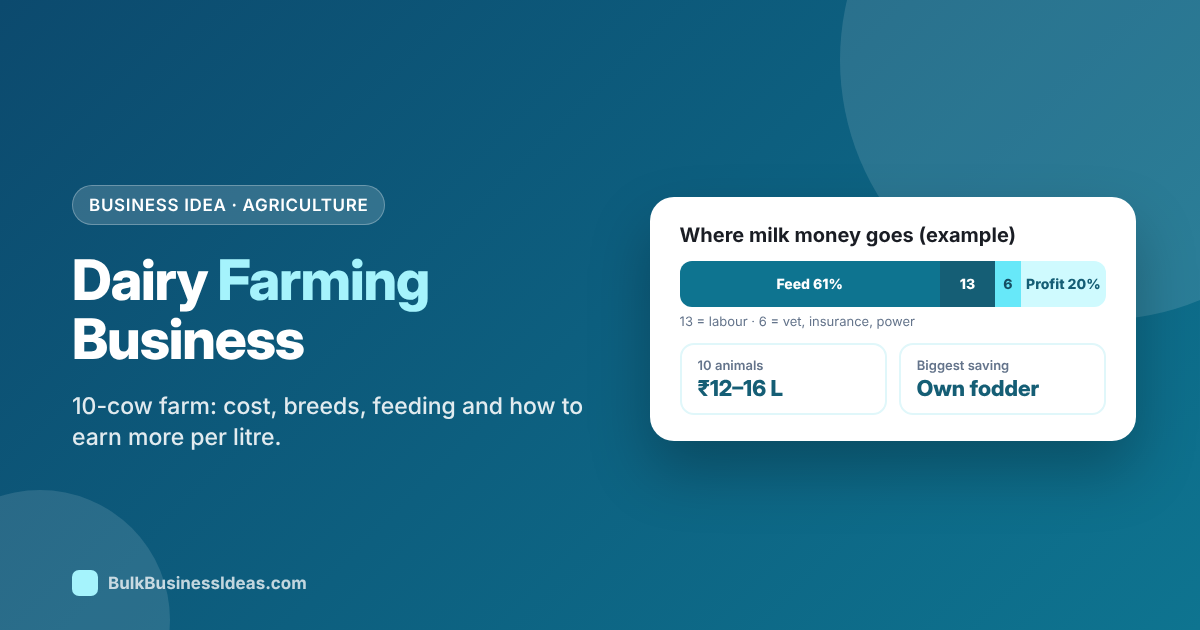
India is the world's largest milk producer, and dairy gives something few businesses do: daily cash income. But dairy profit depends heavily on two things: feed cost and the price you get for milk. Farms that grow their own green fodder and sell milk directly earn much more than those buying all their feed and selling only to collection centres.
Quick Facts (10-Animal Unit) Investment₹12–16 lakh LandShed + 1–2 acres for green fodder (ideal) Daily workMilking twice a day, feeding, cleaning; 1–2 workers Biggest costFeed and fodder (often 60–70% of expenses) Best forFarmers with land, water and time for daily care
Choose Your Animals TypeExamplesNote Crossbred cowsHF cross, Jersey crossHigh milk yield; need good feed and cooling Indian (desi) cowsGir, Sahiwal, Red SindhiHardy; A2 milk sells at a premium BuffaloesMurrah, Jaffarabadi, PandharpuriHigh-fat milk, better price per litre
Tip: Buy animals in early lactation from known farms. Check milk yield over two milkings and get a vet check before buying.
Investment Breakdown (Approx.) ItemCost 10 cows at around ₹80,000 each₹8,00,000 Shed (40–50 sq ft per animal + feeding area)₹3,50,000 Chaff cutter, milking machine, cans, rubber mats, fans₹1,20,000 Insurance, initial feed, vet₹80,000 Total₹13,50,000
Feeding Plan
- Green fodder: Napier hybrid, maize, jowar, berseem. Grow your own, as this is the biggest saving.
- Silage: store green maize as silage for the dry months
- Dry fodder: wheat or paddy straw, kadba
- Concentrate (cattle feed): roughly 1 kg per 2–2.5 litres of milk, plus mineral mixture
Simple Income Example (Monthly)
Average 8 of 10 animals in milk, 12 litres each per day = 96 litres a day.
Milk: 2,880 litres at an average ₹40/litre₹1,15,200 Feed and fodder– ₹70,000 Labour– ₹15,000 Vet, insurance, power– ₹7,000 Profit before EMI₹23,200
Plus income from dung (manure or biogas) and calves.
Indicative only. This example uses mostly purchased feed and co-operative rates. The next section shows how farms earn more.
How to Earn More from Dairy
- Sell direct to homes in packed or loose form at ₹55–70/litre, instead of only to collection centres
- Grow your own fodder and make silage to cut feed cost
- Make value-added products: paneer, ghee, curd, khoa
- Sell A2 milk and ghee from desi cows at a premium
- Sell dung as vermicompost (see Vermicompost Business)
Licences
- Local body or gram panchayat NOC for the shed
- FSSAI registration or licence if you sell packed milk or make dairy products
- Udyam registration for loans and schemes
Loans and Support
- Bank dairy loans: most banks have dedicated dairy loan schemes
- Kisan Credit Card (KCC) for animal husbandry: working capital for feed and care
- PMEGP and Mudra for new units
- State dairy and animal husbandry schemes (they differ by state), plus livestock insurance
- See Government Schemes for MSMEs
Common Mistakes
- Buying high-priced animals without checking actual milk yield
- No plan for fodder in the summer months
- Ignoring heat stress: crossbred cows need fans and foggers
- Poor breeding management, which leaves animals dry for too long
Common Questions Is dairy farming profitable?
Yes, when feed cost is controlled and milk is sold at a good price. A farm that buys all its feed and sells only to collection centres earns thin margins.
Cow or buffalo: which is better?
Cows (especially crossbreds) give more milk. Buffalo milk has more fat and gets a higher rate. Many farms keep both.
How many animals should a beginner start with?
5–10 animals is a practical start. Learn, then grow.
Disclaimer: Costs, milk prices and scheme details are indicative and differ by state. Confirm with your bank and animal husbandry department.
Comments (0)
Login to leave a comment.
No comments yet. Be the first to share your thoughts.