Last updated: October 2026
Chicken and eggs are the most affordable animal protein in India, and demand keeps rising. Poultry farming offers three main paths. Broiler contract farming is the lowest-risk way to start, because a company supplies chicks and feed and pays you a fixed growing charge.
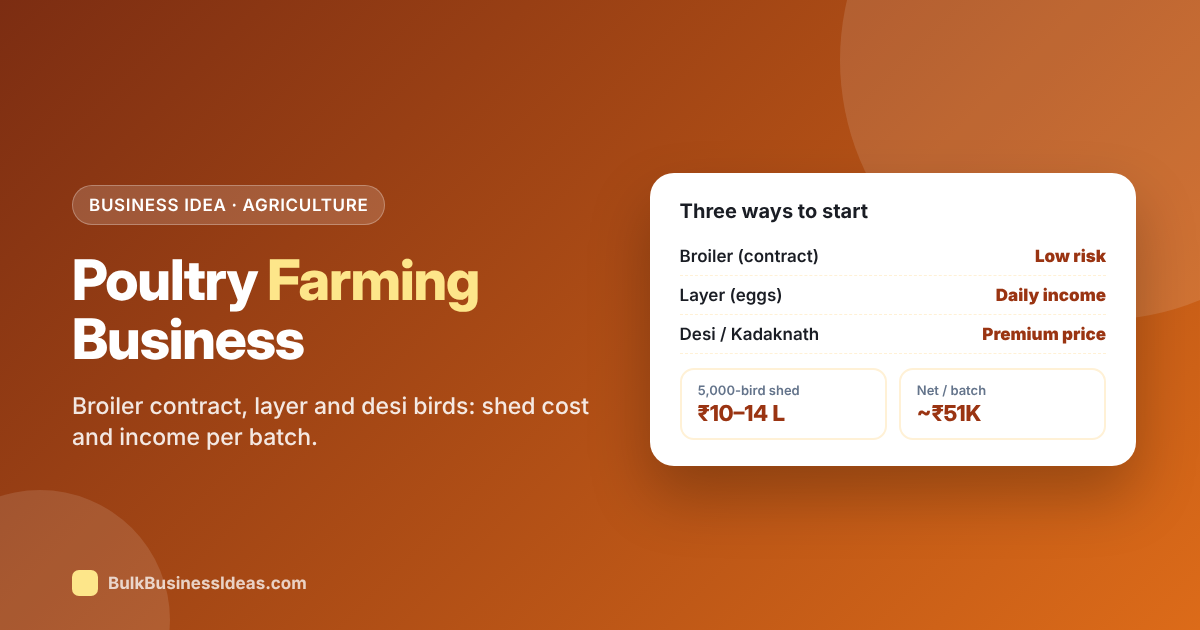
Three Ways to Start Broiler (contract)Layer (eggs)Desi / Kadaknath Investment (typical)₹10–14 lakh (5,000 birds)₹25–40 lakh (5,000 birds)₹2–8 lakh IncomeGrowing charge per kgDaily egg salesPremium bird and egg sales Market riskLow (company buys)Medium–highMedium (you find buyers) CycleAbout 40 days + cleaning72+ weeks per flock4–6 months to sale
Broiler Contract Farming: How It Works
- You provide: land, shed, equipment, labour, electricity, water and litter
- The integrator company provides: day-old chicks, feed, medicines and technical support
- You earn: a growing charge per kg of live bird delivered, with bonuses for good feed conversion and low mortality
Speak to 2–3 integrators in your area and compare growing charges, payment timelines and bonus rules before signing.
Shed for 5,000 Broilers
- About 1 sq ft per bird, so roughly 5,000 sq ft
- East–west length to reduce direct sun, with side curtains and good ventilation
- Feeders, drinkers, brooders, foggers and fans
- Approx. cost: ₹8–12 lakh for the shed + ₹1.5–2 lakh for equipment
Simple Profit Example (Broiler Contract, 5,000 Birds) Per batchAmount Birds delivered: 4,750 (95% survival) × 2.2 kg = 10,450 kg Growing charge at ₹7/kg₹73,150 Power, labour, litter, misc.– ₹22,000 Net per batch₹51,150
With about 6 batches a year: ≈ ₹3.07 lakh, plus about ₹30,000 from litter manure, so ≈ ₹3.37 lakh/year before loan EMI.
Indicative only. Growing charges differ by company and region. Good management (low mortality, good feed conversion) earns bonuses.
Layer Farming (Eggs)
Layer farms need cages, more capital and daily egg marketing. Income is daily, but egg prices swing with season and supply. Suitable after you gain experience, or near cities and bakeries with steady egg demand.
Desi and Kadaknath Birds
Desi chicken and Kadaknath sell at a premium to health-conscious buyers and restaurants. They suit backyard and small free-range farms. Income depends on building your own buyer network: hotels, WhatsApp customers, local markets.
Licences and Rules
- NOC from the gram panchayat or local body
- Pollution Control Board consent may be needed for larger farms (often above about 5,000 birds). Check your state's rules.
- Udyam registration for loans and schemes
- Keep a safe distance from houses and water sources, and follow biosecurity rules
Subsidy and Loans
- National Livestock Mission (NLM): 50% capital subsidy (up to ₹25 lakh) for rural poultry units with a parent farm and hatchery (minimum 1,000 parent birds). Apply via the NLM portal; check the latest guidelines.
- Bank loans, Mudra, PMEGP and state animal husbandry schemes for regular farms
- See Government Schemes for MSMEs
Key Risks and How to Reduce Them
- Disease (e.g. bird flu, Ranikhet): strict biosecurity, vaccination, limited visitors
- Summer heat: foggers, curtains and fans; heat stress kills birds fast
- Price crashes (independent farmers): contract farming removes most market risk
Common Questions Is contract broiler farming profitable?
It gives steady, lower-risk income. Profit depends on shed cost, growing charge and how well you manage each batch.
How many batches a year?
Usually 5–6, with about 15 days of cleaning and disinfection between batches.
Can I start with 1,000 birds?
Yes, especially for desi birds. Many integrators prefer 3,000–5,000+ bird sheds for broilers.
Disclaimer: Costs, growing charges and subsidy details are indicative and change over time. Confirm with integrators, your bank and the animal husbandry department.
Comments (0)
Login to leave a comment.
No comments yet. Be the first to share your thoughts.