Last updated: October 2026
Poha (flattened rice) is a daily breakfast in Maharashtra, Madhya Pradesh, Gujarat and many other states, and it is used in namkeen and chivda too. A poha mill turns paddy into poha using heat and pressure. It is a volume business: margins per kg are small, so steady sales and smart paddy buying decide your profit.
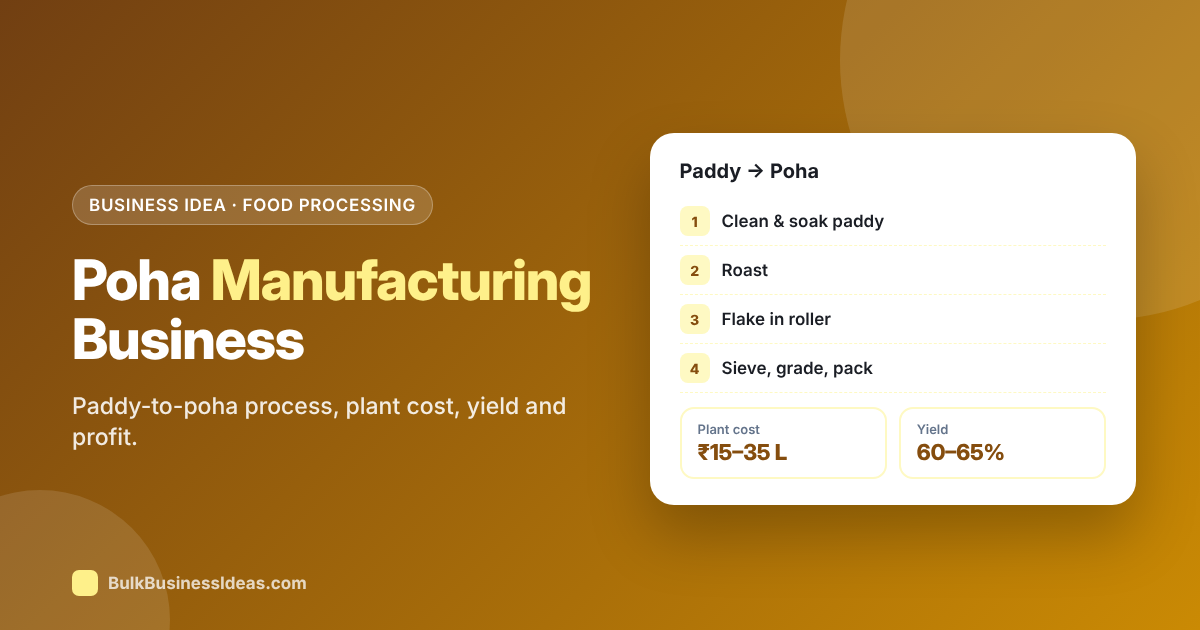
Quick Facts Investment₹15–35 lakh (semi-automatic, 1–2 tonnes/day) Space2,000–4,000 sq ft + paddy storage Staff5–8 people YieldAbout 60–65% poha from paddy Typical margin8–15% Best forLocations near paddy-growing areas with good wholesale contacts
Types of Poha
- Thick (jada) poha: for kanda poha and breakfast
- Medium poha: all-purpose
- Thin (patla / nylon) poha: for chivda and namkeen makers
- Red rice / brown rice poha: health segment, higher price
How Poha is Made
- Cleaning: remove dust, stones and chaff from the paddy.
- Soaking: soak the paddy in water (hot or normal) for several hours.
- Roasting: roast the soaked paddy in a roaster at high heat.
- Flaking: while hot, press it through a flaker (roller) machine, which removes the husk and flattens the grain.
- Sieving and grading: separate the poha from the husk, bran and broken pieces.
- Packing: in 500 g–1 kg retail packs or 25–30 kg wholesale bags.
Machines and Setup
- Paddy cleaner / destoner
- Soaking tanks
- Roaster (wood-, husk- or gas-fired)
- Flaking machine (roller flaker)
- Sieving and grading machine
- Elevators and conveyors (for semi-auto plants)
- Bag stitching or pouch packing machine
Tip: Using rice husk as roaster fuel cuts fuel cost a lot.
Investment Breakdown (Approx.) ItemCost Plant and machinery₹8–20 lakh Shed, tanks, electricals₹3–8 lakh Licences, packing setup₹0.5–1 lakh Working capital (paddy stock)₹4–6 lakh
Licences
- FSSAI licence
- Udyam registration
- GST registration
- Pollution Control Board consent (the roaster has emissions; category depends on your state)
- Legal Metrology registration for retail packs
- Factory licence if you employ 10 or more workers with power
Simple Profit Example (Monthly)
Processing 1,000 kg of paddy a day for 25 days = 25,000 kg paddy.
Poha output (62%): 15,500 kg at ₹55/kg₹8,52,500 By-products (husk, bran, brokens)₹25,000 Paddy cost: 25,000 kg at ₹26/kg– ₹6,50,000 Wages, power, fuel, packing, transport– ₹1,00,000 Profit before tax and EMI₹1,27,500
Indicative only. Paddy and poha prices change with the season and region.
How to Sell
- Wholesale traders and grain markets in 25–30 kg bags (your main volume)
- Namkeen and chivda manufacturers (thin poha)
- Your own branded retail packs for kirana shops and supermarkets
- Hotels, canteens and caterers
Funding Support
A poha unit fits PMEGP (subsidy for new units) and can be financed by a bank loan under CGTMSE (no collateral). Food units may also look at PMFME, but check its current status. See Government Schemes for MSMEs.
Key Risks
- Paddy price swings: buy and store at harvest when prices are lower
- Thin margins: you need steady volume to cover fixed costs
- Quality: moisture and broken poha lower your selling price
Common Questions Which paddy is best for poha?
Many varieties work. Mills usually pick paddy that gives good flakes with fewer broken pieces. Check with local mills and do a small test batch first.
How much poha does 100 kg of paddy give?
Roughly 60–65 kg, depending on paddy quality and machine settings.
Can I add other products later?
Yes. Murmura (puffed rice) and roasted chivda are natural add-ons for a poha unit.
Disclaimer: Costs and profits are indicative examples and vary by location, scale and market prices. Verify licences and scheme rules with the relevant authorities.
Comments (0)
Login to leave a comment.
No comments yet. Be the first to share your thoughts.