Last updated: October 2026
Fly ash is the fine ash left after coal is burnt in thermal power plants. Mixed with sand or stone dust and lime or cement, it makes fly ash bricks that are uniform, strong and need no kiln firing. Government rules promote fly ash products, especially in construction near thermal power plants, which gives this business steady demand.
Quick Facts Investment₹15–35 lakh (semi-automatic to automatic plant) LandAbout 0.5–1 acre (production, curing, stacking) Output5,000–15,000+ bricks a day, depending on machine StandardIS 12894 (fly ash–lime bricks) Best forLocations within reach of a thermal power plant and construction activity
Advantages Over Red Bricks
- Uniform size, so less plaster is needed
- Good strength and lower water absorption
- No kiln, no topsoil use, lower pollution
- Preferred in many government and large private projects
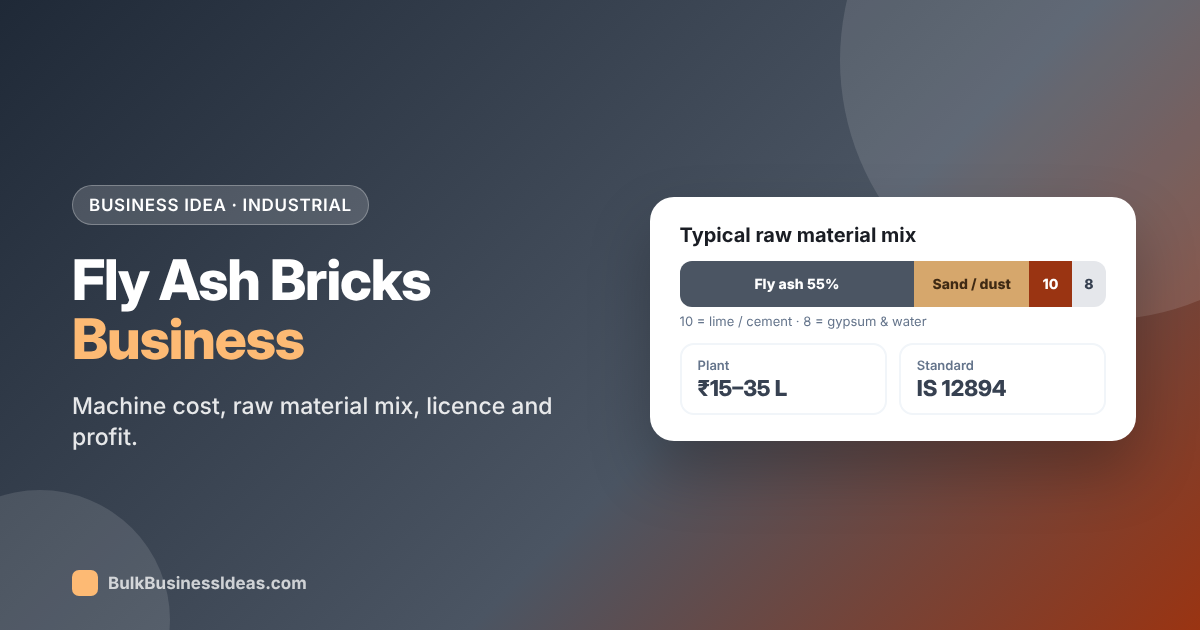
Raw Material Mix (Typical) MaterialApprox. share Fly ash50–60% Sand or stone dust20–30% Lime and/or cement8–12% Gypsum2–5%
Fly ash is available from thermal power plants at low cost, and rules require plants to make it available to users. Contact the nearest plant about supply terms. Transport is often your main raw material cost.
Machines and Setup
- Brick making machine: hydraulic or vibro press (manual, semi-automatic or fully automatic)
- Pan mixer: for uniform mixing
- Conveyor (in semi/fully automatic plants)
- Pallets, trolleys and a curing area with water sprinklers
- A water source, power connection and stacking yard
Process
- Weigh the raw materials in fixed proportion.
- Mix with water in the pan mixer.
- Press into bricks in the machine.
- Air dry for 1–2 days.
- Water-cure for about 14–21 days.
- Stack and dispatch.
Licences
- Udyam and GST registration
- State Pollution Control Board consent (fly ash brick units are often in a lower-pollution category; check your state)
- Land use permission (non-agricultural conversion if needed)
- BIS certification to IS 12894: optional for many buyers, but important for government and large project supply
Simple Profit Example (Monthly)
8,000 bricks a day for 25 days = 2,00,000 bricks.
Sales at ₹5.20 per brick₹10,40,000 Production cost at ₹3.40 per brick (material, labour, power)– ₹6,80,000 Transport, maintenance, admin– ₹1,20,000 Profit before tax and EMI₹2,40,000
Indicative only. Brick prices and raw material costs vary a lot by region. Distance from the fly ash source is key.
Who Buys Fly Ash Bricks?
- Builders and real-estate developers
- Government and PWD contractors (tenders often specify fly ash bricks)
- Individual home builders, through local building material shops
- Infrastructure and industrial projects
Also consider paver blocks and AAC/CLC blocks as add-on products later.
Funding
Fly ash brick plants commonly use PMEGP (within its limits) and CGTMSE-backed bank loans. See Government Schemes for MSMEs.
Common Mistakes
- Poor curing, which gives weak bricks and rejected loads
- Wrong mix ratio to save on lime or cement
- Choosing a site far from the fly ash source, so transport kills the margin
Common Questions Are fly ash bricks better than red bricks?
For most building uses, yes: more uniform, strong and eco-friendly. Quality depends on proper mix and curing.
Can I start with a manual machine?
Yes. Manual and semi-automatic machines suit small starts. Automatic plants suit high volumes.
Is BIS certification mandatory?
Not always for private sales, but government projects and large builders often require bricks meeting IS 12894.
Disclaimer: Costs, prices and rules are indicative and differ by state. Confirm with your State Pollution Control Board and local authorities.
Comments (0)
Login to leave a comment.
No comments yet. Be the first to share your thoughts.