Last updated: October 2026
India is the world's largest producer and consumer of pulses. A dal mill buys whole pulses (tur, chana, moong, urad, masoor), removes the husk, splits them and polishes them into dal ready for the kitchen. It works well near pulse-growing areas like Latur, Akola and Jalgaon in Maharashtra, or Madhya Pradesh, Karnataka and Rajasthan.
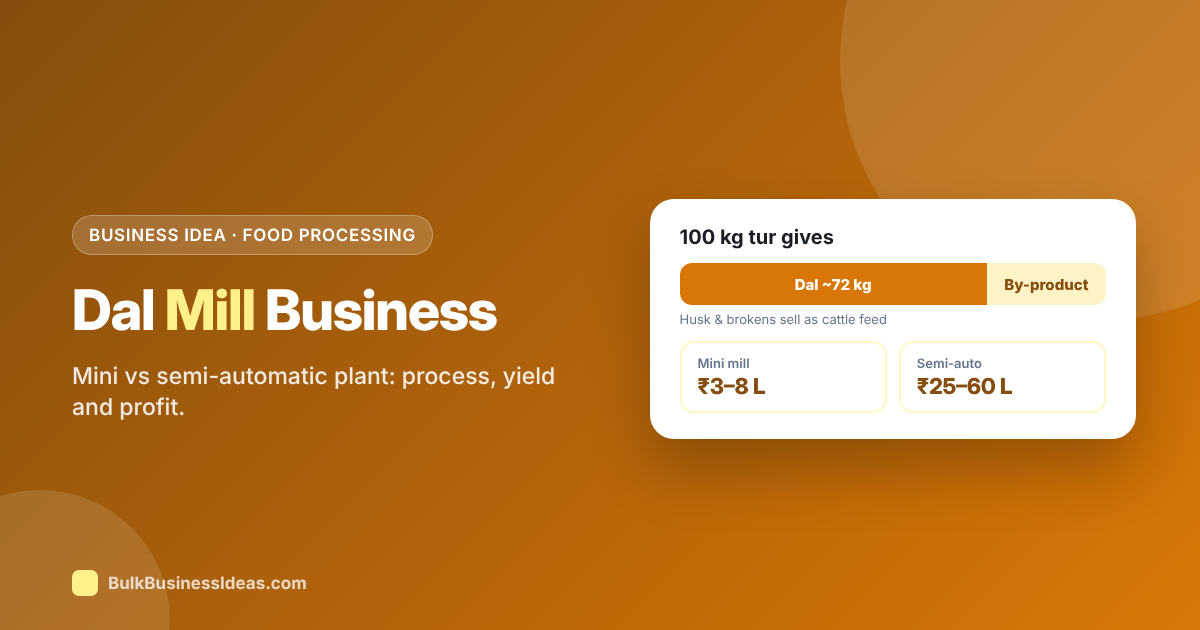
Quick Facts InvestmentMini dal mill: ₹3–8 lakh; semi-automatic plant: ₹25–60 lakh SpaceMini: 500–1,000 sq ft; plant: 3,000+ sq ft + godown YieldAbout 70–75% dal from whole tur (varies by pulse) Typical margin6–10% + by-product income Best forPulse-belt locations; traders wanting to add processing
Mini vs Semi-Automatic Dal Mill
- Mini dal mill: compact machine for village-level processing and custom milling for farmers. Low investment, smaller output.
- Semi-automatic plant: full line with cleaning, pitting, drying, dehulling, splitting, polishing and grading. Higher output for wholesale and branded dal.
Process (Tur Dal Example)
- Cleaning and grading: remove dust, stones and immature grains.
- Pitting: lightly scratch the seed coat so oil and water can enter.
- Oil and water treatment: loosens the husk.
- Drying: sun or mechanical drying.
- Dehulling and splitting: remove the husk and split into two halves.
- Polishing: gives a clean, uniform look (oil, water or plain polish).
- Grading and sorting: separate whole dal, brokens and husk; a colour sorter is used in bigger plants.
- Packing: 30–50 kg bags for wholesale, 500 g–5 kg packs for retail.
Machines
- Pre-cleaner and grader
- Pitting machine
- Dryer (or drying yard)
- Dehuller / splitter (emery roller)
- Polisher
- Grader, and a colour sorter (optional, adds value)
- Elevators, packing and stitching machines
By-Products Add Income
Husk, powder (churi) and broken pieces sell as cattle feed. Brokens are also used by besan and papad makers. Don't ignore this income. It improves your overall margin.
Licences
- FSSAI licence
- Udyam and GST registration
- APMC licence if you buy from mandis (rules vary by state)
- Pollution Control Board consent where required (dust)
- Legal Metrology registration for retail packs
- Watch for stock limit orders the government sometimes imposes on pulses
Simple Profit Example (Monthly, Tur Dal)
Processing 1,500 kg of tur a day for 25 days = 37,500 kg.
Dal (72%): 27,000 kg at ₹110/kg₹29,70,000 By-products: about 9,000 kg at ₹25/kg₹2,25,000 Whole tur: 37,500 kg at ₹75/kg– ₹28,12,500 Power, labour, packing, transport– ₹1,80,000 Profit before tax and interest₹2,02,500
Indicative only. Pulse prices move sharply. Buying right at harvest decides your margin.
How to Sell
- Wholesale traders and grain markets
- Your own branded packs for kirana shops and supermarkets
- Hotels, caterers, hostels, institutional kitchens
- Unpolished and organic dal for the premium health market
- Custom milling for farmers and FPOs (mini mill)
Funding
A dal mill can use PMEGP (new units), a CGTMSE bank loan for machinery and a cash credit limit for stock. See MSME Loan Options.
Common Questions How much dal comes from 100 kg of tur?
Roughly 70–75 kg of dal. The rest is husk, powder and brokens.
Is unpolished dal a good product?
Yes. Demand for unpolished dal is growing in cities, and it sells at a premium.
Can one mill process different pulses?
Yes. Most mills handle tur, chana, moong, urad and masoor with setting changes.
Disclaimer: Costs and profits are indicative examples and vary by location, scale and market prices. Verify licences and scheme rules with the relevant authorities.
Comments (0)
Login to leave a comment.
No comments yet. Be the first to share your thoughts.