Last updated: October 2026
Atta (wheat flour) is eaten daily in most Indian homes. There are two business models: a local chakki that grinds customers' grain for a fee and sells fresh flour, and a packaged atta plant that sells branded flour to shops. The first needs low investment; the second is a high-volume, thin-margin brand business.
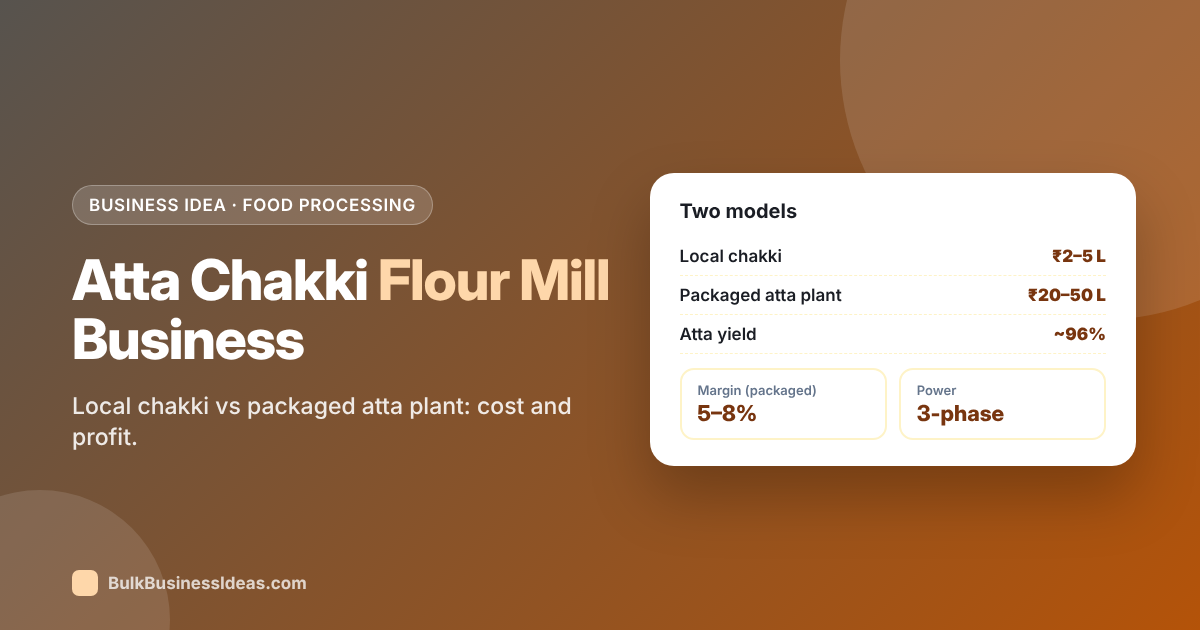
Quick Comparison Local ChakkiPackaged Atta Plant Investment₹2–5 lakh₹20–50 lakh (2–5 tonnes/day) Space200–400 sq ft shop2,000–5,000 sq ft IncomeGrinding charges + fresh flour salesWholesale/retail sale of branded atta MarginGood per kg, low volumeThin per kg (5–8%), high volume RiskLowMedium (wheat price, competition)
Model 1: Local Chakki
- One or two flour mills (stone or emery chakki), a small cleaner and a weighing scale
- Income from grinding charges plus sales of fresh atta, besan, jowar, bajra and multigrain flour
- Add value: multigrain atta, millet flours, fresh besan and home delivery
Model 2: Packaged Atta Plant Machines
- Wheat cleaning line (destoner, separator, scourer)
- Conditioning (tempering) bins
- Chakki mills (stone or plate) or a pulveriser line
- Sifter
- Elevators and conveyors
- Automatic packing machine (1 kg, 5 kg, 10 kg)
Process
- Clean the wheat to remove stones, dust and other grains.
- Temper it with a little water to improve grinding.
- Grind in chakki mills.
- Sieve for uniform fineness.
- Pack with batch number, date and MRP.
Power Connection
Flour mills need a 3-phase commercial or industrial electricity connection. Check the sanctioned load and per-unit tariff before you finalise the location. Power is one of your biggest running costs.
Licences
- FSSAI registration or licence
- Udyam registration
- GST (packaged and labelled atta has GST; check the current rate for your product and pack type)
- Legal Metrology registration for packed products
- Shop and Establishment or trade licence; Pollution Control Board consent where required (dust)
Simple Profit Example (Packaged Atta, Monthly)
Grinding 2,000 kg of wheat a day for 25 days = 50,000 kg wheat.
Atta (96% yield): 48,000 kg at ₹34/kg (wholesale)₹16,32,000 Wheat: 50,000 kg at ₹28/kg– ₹14,00,000 Power, labour, packaging, transport– ₹1,30,000 Profit before tax and EMI₹1,02,000
Indicative only. Branded retail packs, multigrain blends and direct supply to hotels improve margins.
How to Stand Out from Big Brands
- Freshness: "ground this week" is something national brands can't promise
- Local wheat varieties (e.g. Sharbati, Lokwan) that customers already trust
- Millet and multigrain flours: a fast-growing health segment
- Bulk supply to hotels, caterers, roti and chapati makers and canteens
Funding
A local chakki fits a Mudra loan. A packaged atta plant can use PMEGP, a CGTMSE bank loan and a cash credit limit for wheat stock. See MSME Loan Options.
Common Questions Which is better, a stone chakki or a plate mill?
Stone chakkis give traditional, better-tasting atta and are preferred for "chakki fresh" branding. Plate mills are cheaper but run hotter.
Is a flour mill business profitable?
Yes, with steady volume. A local chakki earns well on low investment. A packaged plant needs strong sales and distribution to be profitable.
When should I buy wheat?
Many millers stock wheat after the rabi harvest (April–June), when prices are usually lower.
Disclaimer: Costs and profits are indicative examples and vary by location, scale and market prices. Verify licences and scheme rules with the relevant authorities.
Comments (0)
Login to leave a comment.
No comments yet. Be the first to share your thoughts.