Last updated: October 2026
Goats are called the "poor man's cow". They eat a wide range of fodder, breed quickly and need much less investment than cattle. Mutton prices stay strong, and demand peaks during festivals like Bakri Eid. A well-managed 50-goat unit is a good starting size for a farmer or rural entrepreneur.
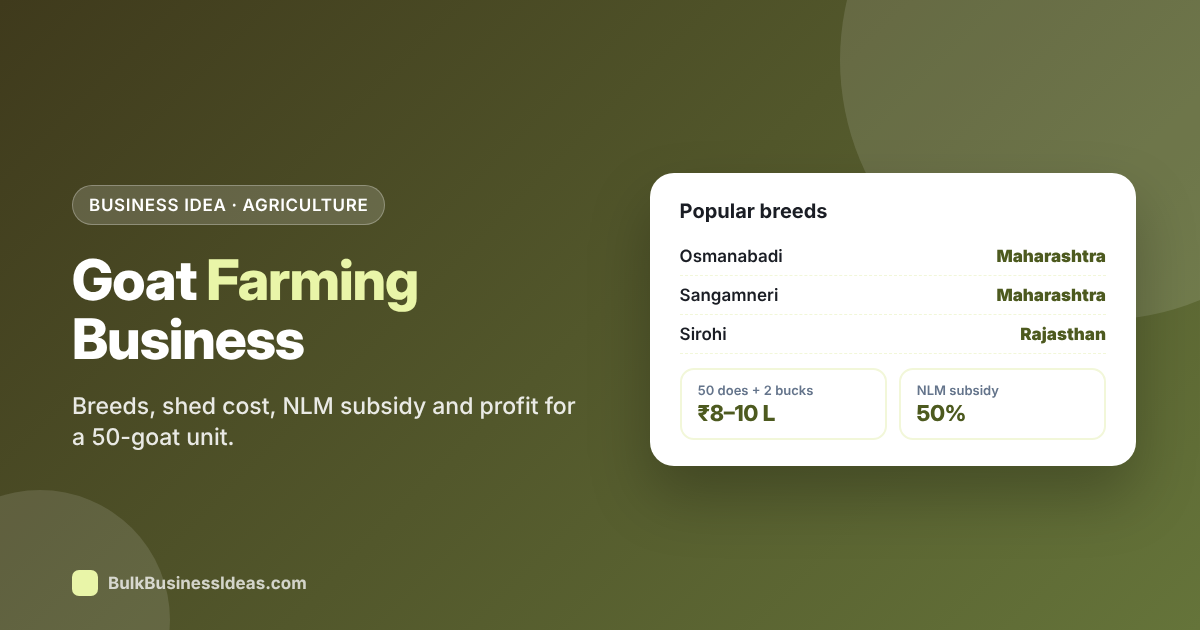
Quick Facts Investment₹8–10 lakh for 50 does + 2 bucks LandAbout 0.5–1 acre (shed + fodder plot) Income startsAround month 10–14 (first kids sold) SubsidyNLM: 50% capital subsidy for breeding units (100+ does) Best forFarmers, rural youth, people with fodder land
Choose the Right Breed BreedRegionWhy choose it OsmanabadiMaharashtraHardy, often gives twins, good meat SangamneriMaharashtraAdapts well to dry areas SirohiRajasthan, GujaratGood body weight, stall-feeding friendly JamunapariUPLarge size, good milk BarbariUP, North IndiaSmall, quick breeding, suits stall feeding
Tip: Choose a breed that does well in your local climate. Buy from known breeders, not random weekly markets.
Shed and Housing
- About 10–12 sq ft per adult goat inside the shed, plus an open run area
- A raised slatted floor (platform) keeps goats dry and reduces disease
- Good air flow and protection from rain and cold
- Separate pens for kids, pregnant does, bucks and sick animals
- Feeders and water troughs off the floor
Investment Breakdown (50 Does + 2 Bucks) ItemApprox. cost 50 does at ₹10,000 each₹5,00,000 2 breeding bucks at ₹20,000 each₹40,000 Shed (low-cost raised platform)₹2,50,000 Feeders, water system, tools₹30,000 Insurance, vaccination, initial feed₹70,000 Total₹8,90,000
Feeding
- Green fodder: grow Napier grass, maize, lucerne and subabul on your own land to cut costs
- Dry fodder: groundnut haulm, tur straw, soybean straw
- Concentrate: 200–400 g per goat per day, more for pregnant and milking does
- Clean water and mineral mixture always available
Health Care
- Vaccinate against PPR, enterotoxaemia and FMD (follow your local vet's schedule)
- Deworm regularly
- Keep the shed clean and dry, since wet floors cause foot and lung problems
- Insure your animals
Simple Profit Example (Yearly, From Year 2) About 100 kids sold at around ₹8,000 each₹8,00,000 Culled adults₹40,000 Manure sales₹30,000 Feed and fodder– ₹2,80,000 Labour– ₹1,20,000 Vet, medicine, insurance, misc.– ₹80,000 Profit before loan EMI₹3,90,000
Indicative only. It assumes good kidding rates and low deaths. Selling before Bakri Eid can raise income significantly.
Where to Sell
- Local traders and weekly animal markets
- Direct to mutton shops and meat processors
- Festival sales (Bakri Eid) at premium prices. Book buyers early.
- Breeding stock to other farmers (higher price for pure breeds)
- Goat manure to nurseries and organic farmers
Government Subsidy: National Livestock Mission (NLM)
Under the NLM entrepreneurship scheme, goat breeding units from 100 does + 5 bucks up to 500 does + 25 bucks can get a 50% capital subsidy (roughly ₹10 lakh for the smallest unit, up to ₹50 lakh for the largest). Applications are made online through the NLM portal (nlm.udyamimitra.in) with a bank loan or proof of own funds. Check the latest guidelines with your district animal husbandry office before applying.
Smaller farms can use a bank loan, Mudra or state schemes. See Government Schemes for MSMEs.
Common Mistakes
- Buying sick or low-quality animals to save money
- No own fodder, so feed costs eat your profit
- Skipping vaccination and deworming
- Starting too big without experience. Learn on a smaller unit first.
Common Questions How many goats should a beginner start with?
20–50 does is a practical start. Scale up to 100+ (and NLM subsidy) once you have experience.
Is stall-fed goat farming possible?
Yes. Many farms use full or partial stall feeding with cultivated fodder. It needs good fodder planning.
Is training available?
Yes. Krishi Vigyan Kendras (KVKs), veterinary universities and state animal husbandry departments run goat farming training.
Disclaimer: Costs, prices and subsidy details are indicative and change over time. Confirm with your district animal husbandry office and bank before investing.
Comments (0)
Login to leave a comment.
No comments yet. Be the first to share your thoughts.